Most consortium coordinators enter their first Horizon Europe project believing the hardest part is behind them. The proposal is won, the Grant Agreement is signed, and the partners are aligned — at least on paper.
By month six, that clarity is usually gone.
Partner management is the operational challenge that no proposal template prepares you for. It is not a question of goodwill or scientific capability. It is a question of structure — and most consortia do not have enough of it.
This article covers the most common partner management failures in EU consortia, why they happen, and what better-structured coordination actually looks like in practice.

Why partner management is harder than it looks
A Horizon Europe consortium is not a single organisation. It is a collection of independent legal entities — universities, research institutes, companies, public bodies — each with their own internal processes, priorities, reporting cultures, and definitions of what “done” means.
The Grant Agreement binds them together legally. But legal obligation does not produce operational alignment. That requires active management — and it falls almost entirely on the coordinator.
What makes this particularly demanding is the combination of factors that converge in every large consortium:
- Partners are geographically distributed across multiple countries and time zones
- Each partner has other projects, other priorities, and limited bandwidth to dedicate to this one
- Communication happens across languages, cultures, and institutional hierarchies
- The project runs for three to five years — long enough for teams to change, priorities to shift, and institutional memory to erode
Note: None of this is exceptional. It is the normal operating environment of a Horizon Europe project. The coordinators who manage it well are not the ones who avoid these challenges — they are the ones who build structures that contain them.
The most common partner management failures
1. Assuming alignment after the kick-off meeting
The consortium kick-off is where everyone agrees on the plan. It is also, frequently, the last time everyone is fully aligned.
After the kick-off, partners return to their institutions and their daily workloads. The shared sense of purpose that existed in the proposal phase gives way to the reality of execution. Without active follow-up, progress tracking, and regular touchpoints, alignment degrades — slowly at first, then suddenly when a deliverable deadline arrives.
Coordinators who assume that kick-off alignment persists without reinforcement are consistently surprised at reporting time.
2. No single source of truth for task ownership
In a consortium of 10 or 15 partners, each involved in multiple work packages, the question of who is responsible for what becomes genuinely complex. When the answer lives in a combination of the GA Annex 1, a shared spreadsheet, and the coordinator’s memory, problems are inevitable.
Partners misremember their commitments. Tasks fall between two partners who each assumed the other was leading. Deliverables are produced by the wrong organisation or to the wrong specification. By the time the confusion is resolved, the deadline has passed.
Clear, shared, accessible task ownership is not a bureaucratic nicety. It is the foundation of functional multi-partner execution.
3. Chasing partners instead of monitoring progress
There is a significant difference between chasing partners for updates and having visibility into what they are actually doing. Most coordinators default to the former — sending emails, scheduling calls, waiting for responses — because they lack the infrastructure for the latter.
Chasing is reactive. By the time a coordinator discovers that a partner is behind, the delay has already happened. Monitoring is proactive — it surfaces problems while there is still time to address them, before they affect deliverables or cascade into other work packages.
The shift from chasing to monitoring requires a shared operational layer that all partners update actively. Without it, the coordinator’s view of project status is always delayed and always incomplete.
4. Treating evidence as a reporting-time activity
In lump sum projects particularly, evidence of task completion is not a formality — it is the basis on which payment is made. But in many consortia, the documentation of what has been done is treated as something to produce at reporting time, not as an ongoing activity throughout execution.
The result is predictable: at the end of a reporting period, partners are asked to retrospectively document work they completed months ago. Memories are incomplete. Files are scattered. Evidence is assembled under pressure, and gaps remain.
Evidence that is not created contemporaneously is fundamentally weaker than evidence that is maintained as work progresses. Auditors know the difference.
5. Not managing the underperforming partner early enough
Every large consortium has at least one partner that consistently underdelivers — submitting late, producing outputs below the agreed specification, or going silent for extended periods. The coordinator’s instinct is often to absorb the problem, redistribute tasks quietly, and avoid the discomfort of a formal conversation.
This instinct is understandable. It is also consistently wrong.
Undermanaged underperformance compounds. A partner that delivers late in month six will deliver late again in month twelve. The tasks quietly redistributed to other partners erode goodwill. And when a formal problem finally surfaces — at a project review, in a financial report, or in an audit — the documentation trail shows that the coordinator knew and did not act.
Addressing underperformance early, formally, and through the governance structures defined in the Consortium Agreement is almost always less costly than managing the consequences of delay.
What better-structured coordination looks like
The coordinators who manage large consortia effectively are not necessarily more experienced or more talented than those who struggle. They are more systematic.
The structural elements that make the difference are:
Shared task ownership that is visible to everyone. Not in the GA annex that nobody re-reads, but in a live operational system that reflects current status, current owners, and current deadlines.
Regular, structured touchpoints with WP leaders. Not ad hoc calls when problems surface, but scheduled progress reviews with a consistent format — what is on track, what is at risk, what needs escalation.
An evidence trail that is built continuously. Meeting minutes, intermediate outputs, sign-offs, test results — whatever is appropriate to the task — maintained from the beginning of the project, not assembled in a rush before the reporting deadline.
Governance that is used, not just documented. A Steering Committee that meets, makes decisions, and records them. An escalation path that partners know exists and will be used if needed.
None of this is complex. All of it requires deliberate investment from day one.
How Kronis PMO supports partner coordination
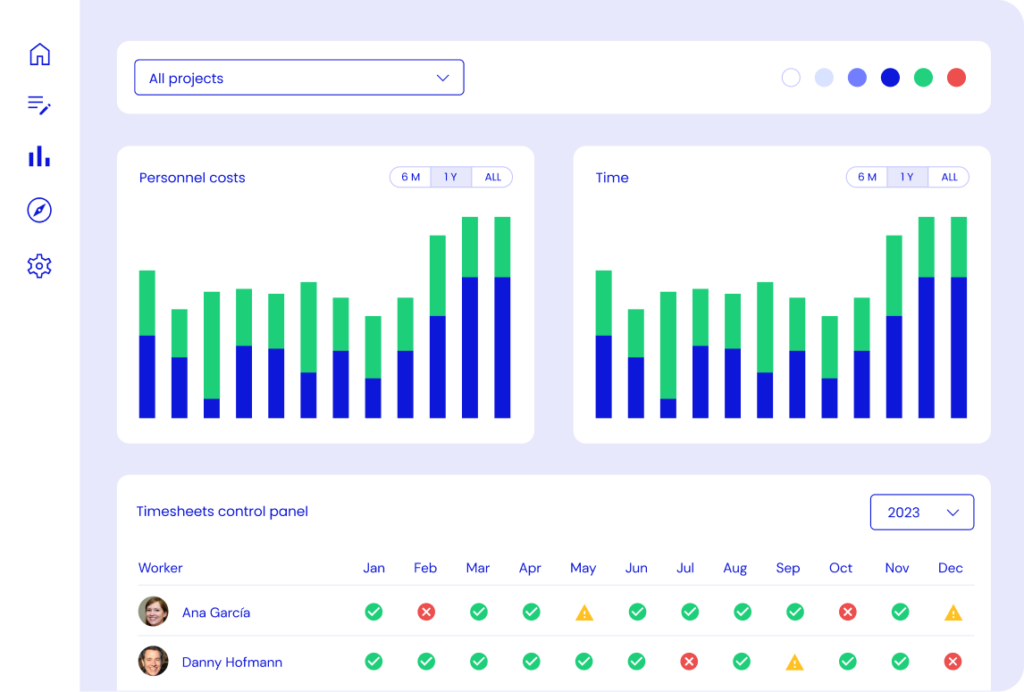
Kronis PMO provides the shared operational layer that multi-partner consortia need but rarely have. It gives the coordinator visibility across all partners and work packages in real time — not through email threads and spreadsheet updates, but through a single system that reflects actual project status.
For each partner, responsibilities are clear. For each task and deliverable, ownership and deadline are visible. For each work package, progress is traceable. And when evidence needs to be attached, the system makes it part of the execution workflow rather than a retrospective exercise.
For coordinators who are currently managing 10, 15, or 20 partners through a combination of email, shared drives, and memory, Kronis PMO is the infrastructure that removes the operational fragility from the project.
Final thoughts
Partner management problems in EU consortia are not caused by difficult partners. They are caused by the absence of structure that would make difficult partner behaviour visible early enough to address it.
The coordinator who builds that structure at the start of the project — clear ownership, active monitoring, continuous evidence, functional governance — spends the project managing execution. The one who does not spends it managing crises.

Work packages in Horizon Europe: how to structure and manage them

What is a Grant Agreement in Horizon Europe and what does it actually commit you to?