Introduction
Horizon Europe is the European Union’s flagship research and innovation funding programme for 2021–2027. With a total budget of €93.5 billion, it is the largest publicly funded R&D programme in the world.
But understanding what Horizon Europe is — what it is trying to achieve, who it is designed for, and what it actually demands from the organisations that participate — requires more than knowing the budget figure. Many teams invest months preparing a proposal without fully grasping the strategic logic behind the programme, the competitiveness of the process, or the operational and financial obligations that begin the moment a Grant Agreement is signed.
This guide covers all of it: the why, the what, the who, and the reality of running a funded project.
Why Horizon Europe exists: the Commission’s strategic priorities
Why Horizon Europe exists: the Commission's strategic priorities
Horizon Europe is not a general-purpose research fund. It is a policy instrument. The European Commission uses it to direct R&D investment towards specific societal challenges and long-term EU objectives — meaning your project, to be competitive, must connect clearly to those priorities.
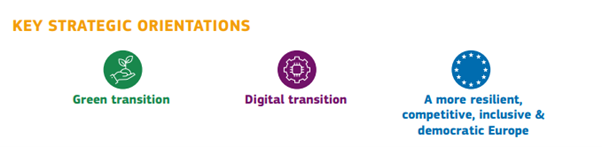
The Horizon Europe Strategic Plan 2025–2027 sets out three key strategic orientations for research and innovation investment in the programme’s final phase: the green transition, the digital transition, and building a more resilient, competitive, inclusive and democratic Europe.
The key strategic orientations for the period 2025-2027 are:
These are not abstract values. They translate into concrete funding targets:
35% of the total Horizon Europe budget is dedicated to climate-related activities, at least €13 billion is allocated to digital research and innovation over the full programme period, and the 2025–2027 Strategic Plan introduces a new target of 10% of the budget for biodiversity-related topics.
In practical terms, this means that proposals which do not demonstrate a credible, specific contribution to these orientations — climate neutrality, digital transformation, or European resilience and competitiveness — are significantly less likely to be funded, regardless of their scientific quality.
Horizon Europe tackles climate change, helps to achieve the UN’s Sustainable Development Goals, and boosts the EU’s competitiveness and growth. It facilitates collaboration and strengthens the impact of research and innovation in developing, supporting and implementing EU policies while tackling global challenges.
Understanding this strategic context is the first step to positioning a proposal effectively. Evaluators are not only assessing the quality of the science — they are assessing whether the project advances the EU’s stated priorities.
How Horizon Europe is structured
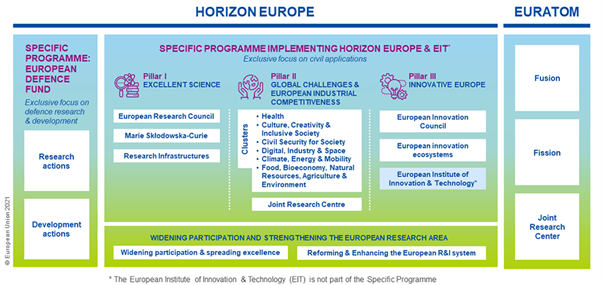
The programme is organised around three main pillars:
Pillar I
Excellent Science Funds frontier research driven by scientific curiosity rather than immediate application. This includes the European Research Council (ERC) grants and Marie Skłodowska-Curie Actions (MSCA), which support individual researchers and mobility programmes.
Pillar II
Global Challenges and European Industrial Competitiveness The largest pillar. Funds mission-driven collaborative research organised around six thematic clusters: Health; Culture, Creativity and Inclusive Society; Civil Security for Society; Digital, Industry and Space; Climate, Energy and Mobility; Food, Bioeconomy, Natural Resources, Agriculture and Environment.
Pillar III
Innovative Europe Focuses on breakthrough and market-creating innovation. This includes the European Innovation Council (EIC) and support for European innovation ecosystems.
Beyond these three pillars, the programme also includes a dedicated component for widening participation and strengthening the European Research Area, designed to reduce disparities between member states.
A note on the European Defence Fund: Whilst not a pillar of Horizon Europe itself, the European Defence Fund (EDF) operates in parallel as a separate EU programme for collaborative defence R&D. Launched in 2021 with a similar consortium-based structure, it follows comparable project management and reporting logic — and is increasingly relevant for organisations operating at the intersection of research and defence technology.
How projects are selected — and how competitive the process is
Projects enter through open calls published on the European Commission’s Funding and Tenders Portal. Each call specifies the topic, the expected outcomes, the budget available, and the evaluation criteria.
Proposals are evaluated by independent experts against three standard criteria:
- Excellence — scientific or technological quality and ambition
- Impact — relevance to the programme objectives and potential societal or economic value
- Implementation — quality of the work plan, team, and management approach
What the criteria do not capture is the reality of the competition. Horizon Europe is oversubscribed — in many calls under Pillar II, success rates sit between 10% and 15%. Differentiation comes not just from scientific quality, but from how clearly the proposal connects to EU priorities, how credible the consortium is, and how well the work plan is structured. Organisations that treat proposal preparation as a bureaucratic exercise rather than a strategic one rarely succeed.
Successful proposals then enter a negotiation phase before the Grant Agreement is signed — not a formality, but a process where the work plan, budget, and consortium composition are finalised and legally committed. Changes requested by the Commission at this stage can be substantial.
What happens after the signature
This is where most project teams underestimate the complexity.
Once the Grant Agreement is signed, the consortium enters a multi-year execution phase. This typically involves:
- Reporting periods with defined deadlines for submitting technical progress reports and financial statements
- Deliverables and milestones that must be completed and evidenced on schedule
- Cost eligibility rules that govern which expenses can be claimed and how they must be documented
- Partner coordination across different organisations, legal systems, and time zones
- Audit exposure that can extend several years beyond the project’s end date
The administrative and operational burden of running a Horizon Europe project is substantial. Many organisations experience their first serious difficulties not during the proposal stage, but during execution — when deadlines accumulate, documentation is scattered, and reporting deadlines arrive without the necessary evidence being in place.
According to the European Commission’s own interim evaluation, published in April 2025, each euro of EU contribution is projected to generate up to €11 in GDP gains by 2045. But that return is only realised when projects are executed properly, deliver on their commitments, and survive financial scrutiny. The funding is the starting point, not the outcome.
The shift to lump sum funding
One of the most significant structural changes in Horizon Europe compared to its predecessor, Horizon 2020, is the broader adoption of lump sum funding schemes — a shift that has accelerated considerably in the final years of the programme.
The Work Programme 2026–2027, adopted in December 2025, allocates approximately half of all call budgets to lump sum funding. Under this model, payment is not based on actual costs incurred. Instead, it is conditional on the successful completion of defined work packages and the delivery of agreed outputs. This fundamentally changes the management challenge: rather than tracking every invoice and timesheet, coordinators must demonstrate that what was promised has actually been delivered — with clear, traceable evidence.
Lump sum projects reduce some administrative burden around cost justification, but they increase the operational pressure on delivery tracking and evidence management.
How Kronis supports Horizon Europe project teams
Managing a Horizon Europe project across multiple partners, reporting periods, and deliverable requirements is an operational and financial challenge that spreadsheets and shared drives are not designed to handle at scale.
Kronis is a SaaS platform built specifically for organisations managing EU-funded R&D projects. Its two core modules — Kronis Finance and Kronis PMO — address the two sides of the management challenge: financial control and justification on one hand, and operational execution and delivery tracking on the other.
For teams preparing to execute a Horizon Europe project, or already in the middle of one, Kronis provides the infrastructure to stay organised, compliant, and audit-ready throughout the project lifecycle.
Key Takeaways
- Horizon Europe is a policy instrument, not a general research fund. Proposals must align with the EU’s strategic priorities — green transition, digital transition, and European resilience — to be competitive.
- Success rates in many calls sit between 10% and 15%. Proposal preparation is a strategic exercise that typically takes months.
- The post-signature phase — execution, reporting, and compliance — is where most operational difficulties arise, and where the real management challenge begins.
- Lump sum funding now covers approximately half of all 2026–2027 call budgets, shifting the management focus from cost justification to delivery evidence.
- Each euro invested by Horizon Europe potentially generates a return of up to €11 in GDP over 25 years — but only when projects are properly executed and financially compliant.


Cost Amendments in Horizon Europe: When You Can Change Your Budget (And When You Can’t)