RIA, IA and CSA: what are the different types of Horizon Europe actions?

Table of Contents

When browsing Horizon Europe calls, you will encounter three acronyms repeatedly: RIA, IA, and CSA. They appear in call titles, in the programme’s Work Programme, and in the submission forms. They are not interchangeable — each represents a fundamentally different type of funded activity, with different objectives, different budgets, different consortium requirements, and different expectations for what a project should deliver.

Choosing the right type of action — or understanding which type a call is funding — is one of the first things any applicant needs to get right.
RIA — Research and Innovation Action

A Research and Innovation Action is the most common project type in Horizon Europe’s collaborative research funding. It is designed to advance knowledge and develop new technologies, products, processes, or services — primarily through research activities.

What it funds: Activities that generate new knowledge or explore new technologies. The emphasis is on scientific and technical investigation, not on bringing a product to market. TRL ranges for RIA projects typically fall between TRL 1 and TRL 5, though some RIAs aim for TRL 6.

Who it is for: Consortia of research organisations, universities, and companies working together on a shared scientific or technical challenge. RIAs are the natural home for projects where the primary output is knowledge, data, methods, or early-stage prototypes.

Funding rate: The standard funding rate for RIAs is 100% of eligible costs for all types of beneficiaries — including companies. This is one of the distinctive features of the RIA: unlike some other EU programmes, private companies in a RIA are reimbursed at the same rate as universities and research institutes.

Typical duration: Three to four years.

What evaluators look for: Scientific excellence and novelty, a credible research methodology, a team with the right expertise, and a clear connection between the research objectives and the call’s expected outcomes. Impact — both scientific and societal — is increasingly weighted in evaluation.

IA — Innovation Action

An Innovation Action is designed to take technologies, products, or services from advanced development towards market readiness. It sits at the higher end of the TRL scale — typically TRL 5 to 8 — and the emphasis is on demonstration, testing, piloting, and validation in real or near-real environments.

What it funds: Activities that demonstrate, test, or validate technologies or solutions that are already at a reasonably advanced stage of development. Prototyping, piloting, demonstration, and pre-commercial testing are typical IA activities. The expected output is a technology or solution that is ready — or close to ready — for market deployment.

Who it is for: Consortia where industry partners play a larger role than in RIAs, given the focus on market-relevant innovation. IAs often involve end users, industrial partners, and public sector organisations alongside research institutions.

Funding rate: The funding rate for IAs is 70% of eligible costs for for-profit organisations and 100% for non-profit organisations, including universities and public bodies. This difference reflects the closer proximity of IA activities to commercial outcomes.

Typical duration: Three to four years, sometimes shorter for highly focused demonstration projects.

What evaluators look for: The viability and credibility of the innovation pathway, the relevance to market needs, the quality of the demonstration plan, and the consortium’s capacity to exploit the results commercially or deploy them at scale.

CSA — Coordination and Support Action

A Coordination and Support Action is fundamentally different from both RIA and IA. It does not fund research or innovation activities directly — it funds coordination, networking, policy support, standardisation, and other activities that support the broader research and innovation ecosystem.

What it funds: Activities such as: building communities of practice across research organisations; supporting the development of standards, guidelines, or policy frameworks; organising conferences, workshops, and training events; producing roadmaps, studies, and reports; coordinating national or regional programmes; and supporting the uptake or dissemination of research results.

Who it is for: Organisations whose primary contribution is coordination, communication, or support rather than research. This includes networks, associations, public authorities, and large research organisations with coordination mandates. Companies can participate, but CSAs are not typically used to fund commercial development.

Funding rate: 100% of eligible costs for all types of beneficiaries.

Typical duration: Two to three years.

What evaluators look for: The quality and relevance of the coordination activities, the reach and representativeness of the network, the expected impact on the research and innovation landscape, and the sustainability of the outcomes beyond the project’s end.

How to tell which type of action a call is funding

Every Horizon Europe call specifies which type of action it is funding — RIA, IA, or CSA — in the call title and documentation. This is not always obvious from the topic description alone, particularly in calls that mix action types.

The key signals are:

  • TRL range: Low TRL (1–5) points to RIA. High TRL (5–8) points to IA. No TRL reference typically points to CSA.
  • Expected outputs: Knowledge, data, and early prototypes point to RIA. Validated demonstrators, pilots, and market-ready solutions point to IA. Frameworks, guidelines, networks, and reports point to CSA.
  • Funding rate: If the call specifies 70% for companies, it is an IA. If it specifies 100% across the board, it is a RIA or CSA.
  • Consortium composition: Calls that explicitly encourage industry-led consortia typically indicate IA. Calls that emphasise research excellence typically indicate RIA.

Some calls combine multiple action types — for example, a call that funds both a RIA and an IA in parallel, as separate projects within the same topic. In these cases, applicants choose which type of action to apply for, and the choice should be driven by the actual stage and nature of their proposed work.

Choosing the right action type

The most important principle is alignment: the action type must match what the project is actually doing.

A project proposing to conduct fundamental research and submit for an IA — because the funding rate or budget is more attractive — will score poorly on impact and implementation criteria. An evaluator looking for a demonstration project will not be convinced by a proposal that is, in substance, a research project dressed up as an innovation action.

The right question is not “which action type has the best terms?” but “which action type accurately describes what we are proposing to do?” The answer to that question should be clear from the project’s objectives, its planned activities, and the TRL range it spans.

How Kronis supports projects across all action types

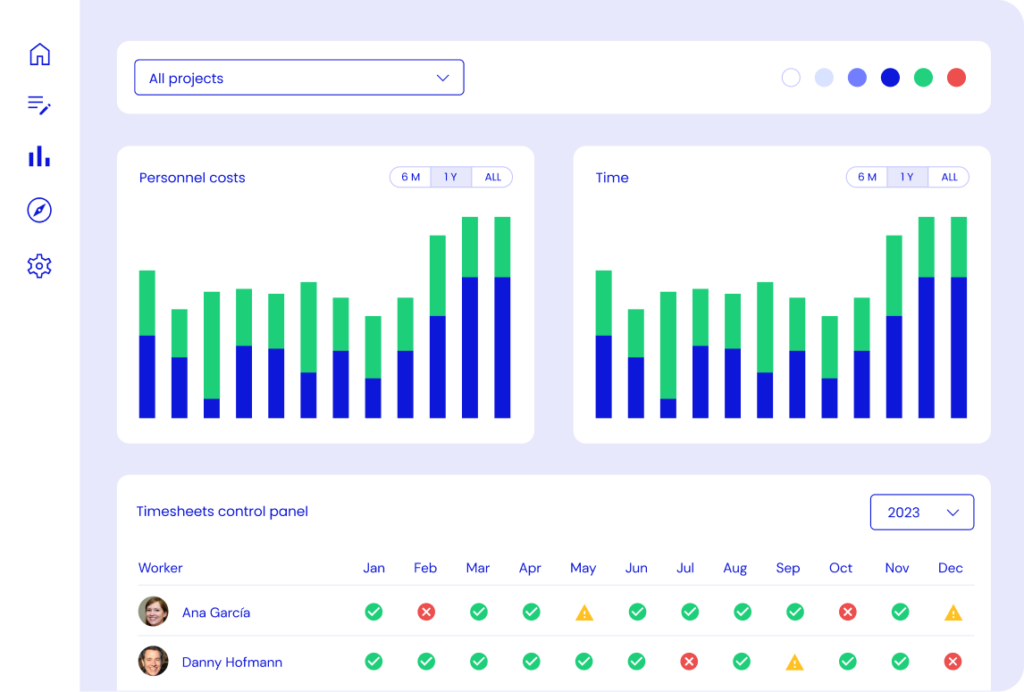
Whether a project is a RIA pushing the boundaries of a new technology, an IA demonstrating a solution in real conditions, or a CSA coordinating a European research network, the operational and financial management challenges are structurally similar: deliverables to track, partners to coordinate, costs to justify, and reports to submit.

Kronis PMO and Kronis Finance provide the management infrastructure that applies across all action types — structured around the Grant Agreement from day one, regardless of whether the project is generating knowledge, validating a prototype, or building a network.

Final thoughts

RIA, IA, and CSA are not interchangeable labels. They define the nature, ambition, and funding structure of a project, and they signal to evaluators what kind of work is being proposed. Understanding the distinction is a prerequisite for writing a competitive proposal — and for choosing the right calls to pursue in the first place.

Kronis Software: The Solution to Navigating EU Funding Complexities

Scroll to Top