
Horizon Europe is built around calls for proposals — open competitions where researchers and innovators submit projects, evaluators assess them, and the best ones receive funding. This is the standard model that governs the vast majority of the programme’s budget.
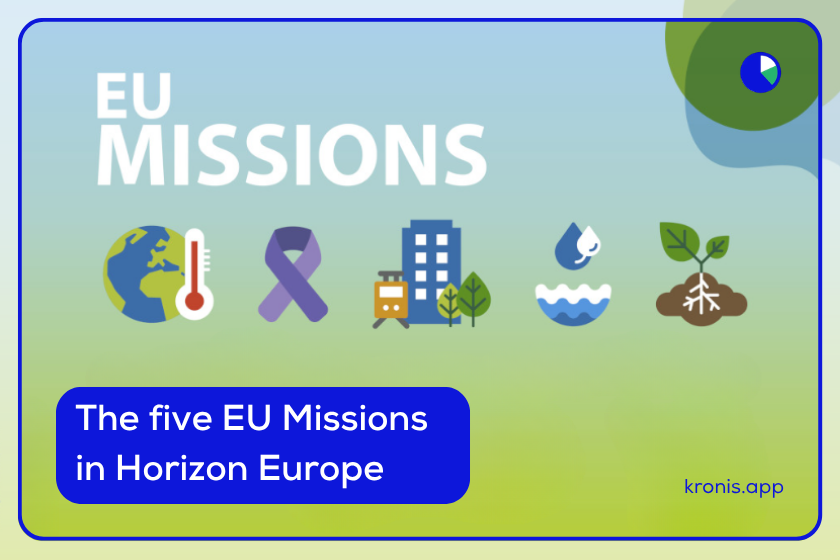
But alongside that standard model, Horizon Europe introduced something structurally different: five EU Missions. They are not calls. They are not programmes within a programme. They are a fundamentally different way of organising EU research and innovation investment — one that is worth understanding clearly, both for organisations considering participation and for executives thinking about where EU funding is heading.
What a Horizon Europe mission is
EU Missions are a new approach in Horizon Europe. They are ambitious, inspiring and measurable goals that mobilise research and innovation to tackle some of our greatest challenges. European Commission.
Each mission defines a specific, measurable objective to be achieved by 2030. Not a research priority, not a thematic area — a concrete target with a deadline. The mission then organises an ecosystem of funding instruments, partnerships, and stakeholder networks to reach that target.
This is the key distinction from a standard Horizon Europe call. A standard call defines a research topic and funds projects that address it. A mission defines an outcome and coordinates everything — calls, partnerships, policy support, public engagement — around achieving it. Individual projects funded under a mission contribute to a larger, defined goal. They are not ends in themselves.
The five EU Missions
Mission on cancer
Ambition: Improve the lives of more than 3 million people living with, through, and beyond cancer by 2030, through better prevention, diagnosis, treatment, and quality of life.
The Cancer Mission is one of the highest-profile EU Missions, given the direct societal relevance of its objective. It funds research across the full cancer pathway — from early detection and diagnosis to treatment innovation and survivorship support. The Mission is managed by HaDEA and has a dedicated implementation plan that coordinates Horizon Europe funding with the EU’s Beating Cancer Plan.
Mission on climate change adaptation
Ambition: Support at least 150 European regions and communities to become climate-resilient by 2030.
The EU Mission on Adaptation with a budget of €226 million in 2026-2027 focuses on accelerating climate adaptation action, strengthening multi-level cooperation, and supporting the deployment of concrete adaptation solutions on the ground. It covers everything from flood and drought resilience to heatwave preparedness and cultural heritage protection.
Mission: 100 climate-neutral and smart cities
Ambition: Support 100 European cities to become climate-neutral and smart by 2030, serving as innovation hubs for other cities across Europe and globally.
The EU Cities Mission with a budget of €220 million in 2026-2027 supports cleaner urban energy and mobility systems and promotes more circular, efficient infrastructure. The 100 cities selected for the mission — spanning all EU member states — receive dedicated support, including access to the Climate City Capital Hub and the Twinning Learning Programme that pairs cities to share knowledge and accelerate action.
Mission: a soil deal for Europe
Ambition: Lead the transition towards healthy soils by 2030, with at least 75% of soils in each EU member state reaching healthy status or showing significant improvement.
The EU Soil Mission with a budget of €246 million in 2026-2027 aims to strengthen soil health through improved monitoring, sustainable land management, and living labs that restore ecosystems and enhance long-term resilience.
How missions differ from standard Horizon Europe calls
Understanding the practical differences helps organisations assess whether mission funding is relevant to their work — and how to engage with it.
Outcome-driven, not topic-driven. A standard call defines what research should be done. A mission defines what change should happen by 2030 and funds whatever contributes to it. This gives missions more flexibility in the types of projects they support — but it also means that proposals must demonstrate a direct, credible contribution to the mission’s specific 2030 target, not just general relevance to the thematic area.
Multi-instrument. Missions do not fund only through competitive calls. They also use partnerships, procurement, prizes, and direct support to cities, regions, and communities. A call under a mission is one mechanism among several — and understanding the full ecosystem helps organisations identify the right entry point.
Stakeholder engagement is central. Missions are designed to mobilise not just researchers and innovators, but policymakers, industry, civil society, and citizens. Projects funded under missions are expected to engage with this broader ecosystem — not just produce research outputs.
Managed by specific agencies. Each mission is managed by one of the Horizon Europe executive agencies. The Cancer Mission is managed by HaDEA. The Climate, Oceans, Cities, and Soil Missions are managed by CINEA. This determines who your Project Officer will be and which agency’s processes you will follow.
Standard project types apply. The projects funded under mission calls are standard RIAs, IAs, and CSAs — the same action types as the rest of Horizon Europe. The Grant Agreement, the reporting obligations, the financial eligibility rules, and the audit framework are identical. Being part of a mission does not change how a project is managed once funded.
Who can participate in mission calls
Eligibility for mission calls follows the standard Horizon Europe rules. Most calls require a consortium of at least three independent legal entities from three different EU member states or associated countries. Universities, research organisations, companies, SMEs, public authorities, and NGOs are all eligible — and mission calls frequently emphasise the importance of multi-actor consortia that bring together research, industry, and public sector partners.
Cities and regions play a particular role in the Cities and Adaptation Missions, where territorial actors are not just eligible but often the primary intended participant. For organisations in local and regional government, mission calls are one of the most direct routes into Horizon Europe funding.
How to find and apply for mission calls
Mission calls are published on the EU Funding and Tenders Portal alongside all other Horizon Europe calls. They are identifiable by the “MISS” prefix in the call reference — for example, HORIZON-MISS-2026-CANCER or HORIZON-MISS-2026-OCEAN.
Each mission also has its own dedicated platform and community on the Commission’s research and innovation website, which provides guidance on the mission’s objectives, the types of projects being sought, and the broader stakeholder ecosystem. For organisations new to mission funding, attending the dedicated Mission Info Days — organised by the Commission at the start of each call cycle — is strongly recommended.
The National Contact Points for the relevant thematic areas can also provide guidance on which mission calls are most relevant to your organisation’s work and how to position a proposal competitively.
How Kronis supports mission-funded projects
A project funded under a Horizon Europe mission is, operationally and financially, a standard Horizon Europe project. The work packages, deliverables, reporting periods, cost eligibility rules, and audit obligations are identical to any other RIA or IA.
What changes is the strategic context and the stakeholder ecosystem the project operates within. Coordinating a large consortium — often spanning research, industry, cities, and civil society — within the governance framework of a mission requires exactly the kind of operational clarity that Kronis PMO provides: shared visibility across partners, structured deliverable tracking, and a continuous evidence trail that serves both the Project Officer’s technical review and the mission’s broader accountability framework.
Final thoughts
Horizon Europe Missions represent a genuine shift in how EU research funding is organised — from funding good science towards defined change. For organisations whose work is directly relevant to one of the five mission targets, they offer a compelling entry point: larger budgets, longer timeframes, and a clear societal purpose that strengthens both the proposal and the project’s eventual impact case.
The management challenge, once funded, is the same as any other Horizon Europe project — just at greater scale and with a wider stakeholder ecosystem to navigate.
From grant searching to managing it: see Kronis at Startup Olé 2026
Horizon Europe vs cascade funding: which route is right for your organisation?