Introduction
Managing one Horizon Europe project is demanding. Managing three or five simultaneously can feel impossible.
Different reporting deadlines. Multiple partners per project. Overlapping deliverables. Budget tracking across work packages. Audit trails for every cost. Coordination with finance teams who are juggling the same chaos.
Most project managers handle this by working longer hours. They build more spreadsheets. They send more emails. They hope nothing slips through the cracks.
But hope is not a strategy. And spreadsheets are not infrastructure.
If you’re managing multiple EU-funded projects, you need a system that scales. One that keeps data organised, deadlines visible, and partners coordinated—without requiring you to work 60-hour weeks.
This guide explains why multi-project management breaks down, what actually goes wrong, and how to regain control without burning out.

Why Managing Multiple Projects Feels Impossible
The challenge isn’t just the workload. It’s the coordination overhead.
Every additional project multiplies the complexity:
- Different reporting schedules mean constant context-switching between projects at different stages
- Multiple partner consortia mean managing 15-30 different organisations across your portfolio
- Overlapping deliverables mean tracking dozens of deadlines simultaneously
- Separate budgets mean maintaining cost allocation accuracy across projects
- Different work package structures mean remembering which activities belong to which project
Add to this:
- Finance teams asking for timesheet justifications across all projects
- Partners submitting reports late (or not at all)
- The granting authority requesting clarifications on Project A while you’re trying to close reporting for Project B
- Your own organisation expecting you to also contribute to proposal writing and business development
The result? Constant firefighting. No time for strategic oversight. And the nagging fear that you’ve forgotten something critical.
What Actually Goes Wrong in Multi-Project Management
When project managers lose control of multiple projects, it’s rarely because of a single catastrophic failure. It’s death by a thousand small mistakes:
1. Missed Deadlines
You’re so focused on Project A’s interim report that Project B’s deliverable submission date passes without notice. By the time you realise, you’re already in breach of the Grant Agreement.
2. Inconsistent Data
Your timesheet for January shows 120 hours on Project A, but your financial statement only claims 100 hours. The discrepancy triggers questions from the granting authority. You spend days reconstructing what actually happened.
3. Lost Documents
A partner asks for the signed consortium agreement from 18 months ago. You know you saved it somewhere. But where? In email? On a shared drive? In a local folder that three people have access to?
You spend an hour searching. The partner is frustrated. You look disorganised.
4. Budget Allocation Errors
An invoice arrives that could legitimately be charged to either Project A or Project B. You make a quick decision and move on. Six months later, an auditor questions the allocation. You can’t remember why you made that choice.
5. Partner Coordination Chaos
You send an email to the Project A consortium. Three partners respond. Two don’t. You follow up individually. One partner replies saying they thought the deadline was next month. You realise you sent the wrong project timeline by mistake.
These aren’t hypothetical scenarios. They happen regularly to project managers juggling multiple grants.
The Spreadsheet Problem
Most project managers try to solve multi-project chaos by building better spreadsheets.
A master timeline tracking all deadlines. A budget tracker consolidating costs across projects. A partner contact database. A deliverable status log.
But spreadsheets have fundamental limitations:
- They don’t scale. Adding a new project means rebuilding formulas, copying sheets, and updating references. Every change introduces new opportunities for error.
- They don’t centralise data. Your timeline is in one file. Your budget tracker is in another. Your deliverable log is in a third. Keeping them synchronised requires manual updates.
- They don’t enforce consistency. If Partner X submits their timesheet in a different format than you expected, you manually adjust. Multiply this by 20 partners and 5 projects, and you’re spending hours reformatting data.
- They don’t provide visibility. Your finance team can’t see project status. Your CEO can’t see portfolio performance. Information lives in your laptop, accessible only to you.
Spreadsheets worked when you had one project. At three or five projects, they become the problem.
What Multi-Project Management Actually Requires
If you’re managing multiple EU-funded projects, you need three things:
1. Centralised Data Storage
All project information—timesheets, costs, deliverables, partner communications, consortium agreements—must live in a single, searchable repository.
This means:
- No more hunting through email threads for a decision made six months ago
- No more asking partners to resend documents you know you saved somewhere
- No more maintaining separate filing systems for each project
Everything in one place. Always accessible. Audit-ready.
2. Automated Deadline Tracking
You should not be manually checking calendars to see what’s due next week.
A proper system:
- Tracks all reporting deadlines, deliverable due dates, and milestone reviews
- Sends reminders before deadlines (not after)
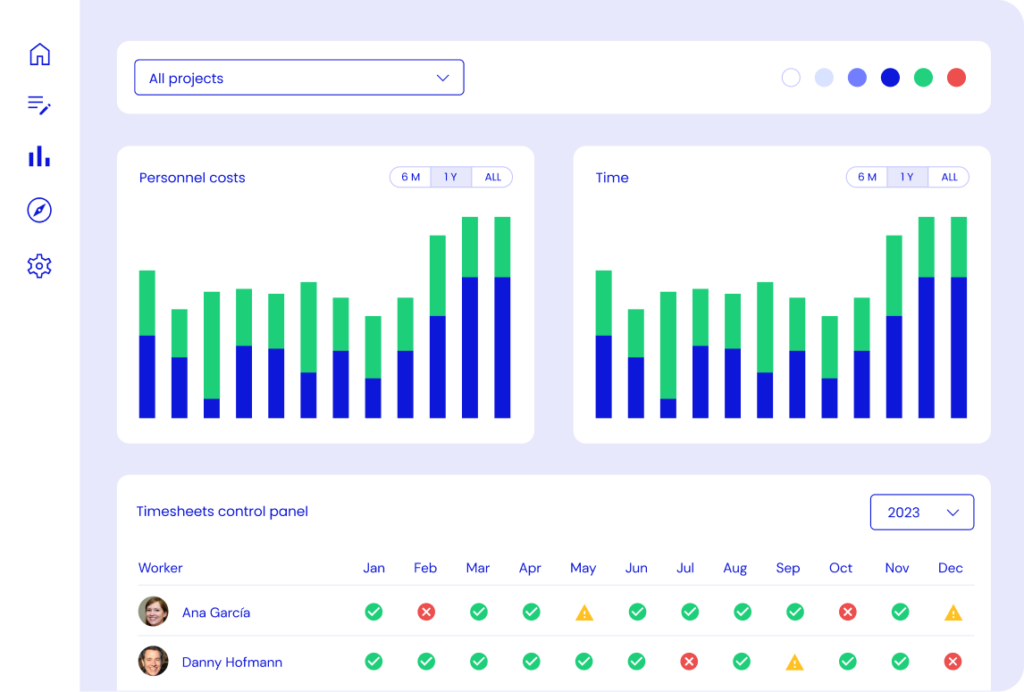
- Shows upcoming obligations across all projects in a single dashboard
You should be able to log in and immediately see: “Project A interim report due in 14 days. Project B deliverable 3.2 due in 21 days. Project C partner reports due in 28 days.”
3. Consistent Data Templates
When partners submit timesheets, cost reports, or deliverables, they should all use the same format. This eliminates hours of manual data reformatting.
A digital system enforces this by:
- Providing pre-structured templates for each data type
- Validating entries before submission (catching errors early)
- Auto-populating reports with consistent, traceable data
This doesn’t just save time. It reduces errors.
How to Regain Control Without Working More Hours
The solution isn’t to work harder. It’s to work differently.
Step 1: Centralise Before You Scale
If you’re about to take on a new project, don’t add it to your existing spreadsheet system. That’s like adding weight to a structure that’s already cracking.
Instead, move your existing projects into a centralised system first. Then add new projects to that system.
This means:
- Migrating key documents to a single repository
- Standardising data formats across projects
- Building repeatable workflows
Yes, this takes time upfront. But it prevents the chaos from getting worse.
Step 2: Automate What Repeats
Every task you do more than once per project should be automated or templated.
Examples:
- Timesheet collection from partners
- Budget vs. actual cost tracking
- Deliverable submission and version control
- Financial statement preparation
A digital control system like Kronis handles this automatically:
- Partners submit data through structured forms
- Costs are linked to work packages and supporting documents
- Reports are pre-filled from real project data
- Evidence is stored and traceable
This doesn’t just save time. It eliminates the risk of forgetting a step.
Step 3: Make Data Visible to Your Team
Multi-project management shouldn’t be a solo operation.
Your finance team should see which costs are pending approval. Your CEO should see portfolio performance. Your partners should see their obligations.
A centralised system provides:
- Role-based access (everyone sees what they need, nothing more)
- Real-time dashboards (no more “Can you send me the latest budget?” emails)
- Audit-ready traceability (every change is logged and attributable)
This reduces coordination overhead and distributes accountability.
Step 4: Build Repeatable Processes
Every project should follow the same basic workflow:
- Kick-off → Data collection → Reporting → Review → Closure
If each project uses a different process, you’re constantly relearning how things work.
Standardise:
- How partners submit data
- How costs are approved
- How deliverables are reviewed
- How evidence is stored
This makes scaling easier. Project 6 should be easier to manage than Project 3, not harder.
What Happens When You Get This Right
When multi-project management is properly structured, you gain:
- Time back in your week. Reporting preparation drops from 3 weeks to 3 days.
- Confidence in your data. You know where every document is and can produce it on demand.
- Reduced stress. Deadlines are visible. Partners are coordinated. Nothing is forgotten.
- Ability to scale. Adding a new project doesn’t double your workload.
And perhaps most importantly: you stop firefighting and start managing strategically.
You can see patterns across projects. Identify which partners consistently deliver late. Spot budget risks early. Plan ahead instead of reacting.
Final Thought
Managing multiple Horizon Europe projects is hard. But it doesn’t have to be chaos.
The organisations that scale EU-funded R&D successfully don’t just hire more project managers. They build systems that make multi-project management sustainable.
They centralise data. Automate repetitive tasks. Enforce consistent processes. Make information visible to the whole team.
If you’re managing 3+ projects and feel like you’re constantly behind, the problem isn’t you. It’s your infrastructure.
Fix the system, and the stress follows.

The Hidden Cost of Manual EU Grant Management (And Why It Matters)

Audits, Checks and Financial Control in Horizon Europe Projects