Many organisations celebrate when their Horizon Europe proposal is successful. Fewer take the time to read the Grant Agreement carefully before signing it.

The Grant Agreement (GA) is the legal contract between the consortium and the European Commission. It defines everything: what must be delivered, when, how costs must be documented, what constitutes a reportable problem, and what the Commission can do if obligations are not met. It is not a formality. It is the foundation document that governs the entire project lifecycle.
This article explains what the Grant Agreement contains, what obligations it creates, and what the consequences of non-compliance look like in practice.
What the Grant Agreement is
The Grant Agreement is a binding legal document signed between the coordinating organisation and the European Commission (or the relevant funding body, such as the European Research Executive Agency). All consortium partners are bound by its terms, either directly through co-signing or through the internal Consortium Agreement.
In Horizon Europe, the GA follows a standard structure — the Model Grant Agreement (MGA) — which is publicly available and applies to all standard collaborative projects. While specific annexes vary by project, the core structure and legal framework are consistent across the programme.
The GA is accompanied by several annexes that are just as legally binding as the main text:
- Annex 1 (Description of Action): The technical work plan — what will be done, by whom, and by when. This is the operational backbone of the project.
- Annex 2 (Estimated budget): The financial plan, broken down by partner and budget category.
- Annex 3 (Specific conditions): Any derogations or additional requirements that apply to this particular project.
Note: Reading only the main GA text without the annexes is a common mistake. Annex 1 in particular contains the deliverable specifications, milestone definitions, partner task assignments, and completion criteria that will be evaluated at every reporting period.
Core obligations under the Grant Agreement
Technical implementation
The consortium must implement the project as described in Annex 1. This means:
- Completing all tasks assigned to each partner
- Producing all deliverables by the dates specified
- Achieving all milestones by the dates specified
- Reporting on progress honestly and accurately at each reporting period
Deviations from the approved work plan are possible but require formal justification. Significant changes — adding or removing partners, reallocating substantial budget, changing key objectives — typically require a formal amendment to the GA.
The GA does not allow for silent adaptation. If the project is not going as planned, the coordinator is required to inform the Project Officer and, in many cases, propose corrective action.
Financial obligations
Every cost claimed must be:
- Actually incurred — not estimated, not planned, not anticipated
- Incurred during the project period — costs before the start date or after the end date are ineligible
- Necessary for the project — directly linked to the activities in Annex 1
- Identifiable and verifiable — supported by documentation that an auditor could review
- Compliant with the beneficiary’s usual accounting practices
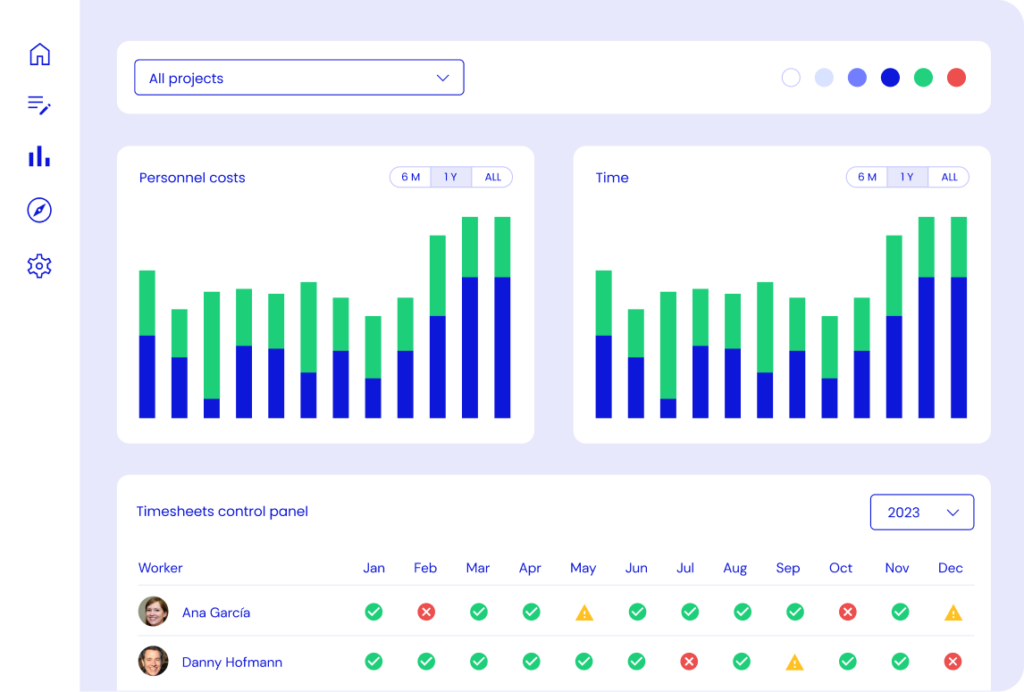
Personnel costs — typically the largest budget item — require evidence of actual hours worked on the project, linked to specific work packages. This is what timesheets are for. The GA does not specify a particular timesheet format, but the records must be sufficient to demonstrate that the claimed hours were actually spent on project activities.
Indirect costs (overheads) are covered by a flat rate of 25% of direct eligible costs, excluding subcontracting and third-party costs. This simplifies overhead justification but does not reduce the documentation requirements for direct costs.
Reporting obligations
The GA specifies reporting periods, typically every 12 to 18 months for collaborative projects. At the end of each reporting period, the consortium must submit:
- A technical progress report covering scientific and operational progress, deliverables, and milestones
- Financial statements from each beneficiary, detailing costs incurred per budget category
- A summary financial report consolidated by the coordinator
For projects exceeding €325,000 in claimed costs per beneficiary, a Certificate on Financial Statements (CFS) — signed by an independent auditor — is required. This is not optional, and failure to provide it on time delays payment.
Information and audit rights
By signing the Grant Agreement, each beneficiary grants the European Commission, the European Anti-Fraud Office (OLAF), the European Court of Auditors, and any authorised representatives the right to audit their records — financial and otherwise — during the project and for up to five years after the final payment.
This is not theoretical. Audits happen. They can be triggered by risk-based selection, by anomalies in reported data, or by complaints. The five-year window means an organisation that closes its project in 2026 could still be audited in 2031.
What happens when obligations are not met
The GA defines several categories of consequence for non-compliance, ranging from payment reduction to contract termination.
Rejected costs: If costs are found to be ineligible — whether at reporting stage or during an audit — they are rejected and not reimbursed. If they have already been paid, recovery is initiated.
Systemic findings: If an audit identifies a systemic error — for example, a fundamental problem with how personnel costs are calculated — the finding may be extrapolated to other EU projects run by the same organisation, not just the one being audited. This is a risk that many finance teams underestimate.
Suspension and termination: In cases of serious breach, the Commission can suspend payments or terminate a beneficiary’s participation. In extreme cases, the entire project can be terminated.
Recovery: If a beneficiary has received funds that are subsequently found to be unjustified, the Commission issues a recovery order. Interest accrues on the amount owed.
Note: None of these outcomes are common in well-managed projects. But they are not rare either. Most problems originate not in fraud or deliberate misrepresentation, but in disorganisation — missing documentation, poorly maintained records, costs that cannot be traced to project activities.
The amendment process
The GA can be amended after signature, but the process has rules.
Minor changes — such as reallocation of budget between budget categories within the same partner, delays in deliverables, or changes to team members — can often be handled through the Project Officer without a formal amendment.
Major changes — adding or removing partners, changing the coordinator, significant changes to the work plan or budget structure — require a formal amendment request, review by the Commission, and counter-signature. These processes take time. Attempting to implement major changes without formal amendment creates compliance risk.
How Kronis supports Grant Agreement compliance
The Grant Agreement defines what must be done. Kronis provides the operational and financial infrastructure to actually do it.
Kronis PMO structures project execution around Annex 1 — turning the work plan into trackable tasks, deliverables, and milestones with clear ownership across partners. Kronis Finance ensures that costs are recorded, categorised, and documented in a way that is audit-ready from day one.
For teams that want to move from the Grant Agreement as a document to the Grant Agreement as a living management tool, Kronis provides the layer that makes that possible.
Final Thoughts
The Grant Agreement is signed once. Its obligations run for the entire project lifetime — and beyond, given the five-year audit window. Most of the difficulties that arise during execution are not caused by the complexity of the rules themselves, but by the gap between what the GA requires and how the project is actually being managed day to day.
Closing that gap early — with clear ownership, consistent documentation, and financial records that are audit-ready from the start — is significantly less costly than trying to reconstruct it under pressure at reporting time.


How a Horizon Europe consortium works: roles, responsibilities and governance