
Once an open call closes, the programme faces a different problem: a stack of applications, a deadline to select, and a process that has to hold up if anyone asks how the decisions were made. For programmes that pass EU funding on to third parties, “defensible” means being able to show that selection was objective, transparent and free of conflicts of interest. The scoring process is where that is won or lost.
What the rules expect from the selection process
When a Horizon Europe project provides financial support to third parties (FSTP), the Grant Agreement sets the frame. The conditions for the support must ensure objective and transparent selection procedures, and Annex 1 must describe the criteria and procedures for giving the support.
The Commission’s good-practice guidance on FSTP adds the working detail. It says calls must be open and published widely, and follow EU standards on transparency, equal treatment, conflict of interest and confidentiality.
Some schemes have stricter rules. For Horizon Europe Co-funded Partnerships, Annex 5 requires proposals to be evaluated with the assistance of at least three independent experts, selection on the basis of a ranking, and a report by an independent expert observer. These requirements apply to co-funded calls, not to every FSTP call, so always check your own Grant Agreement and call conditions.
Five building blocks of a defensible evaluation
1. Fix the criteria and scoring before the call opens
Applicants and evaluators should work from the same criteria, set before the call opens. The Commission’s guidance includes an optional example evaluation form for beneficiaries without their own templates. In it, scoring uses a 0 to 5 scale with half marks allowed, minimum thresholds apply, and scores are normally unweighted unless the call specifies otherwise.
Your call conditions define your own criteria and thresholds. What matters is that they are fixed in advance and applied to every proposal.
2. Separate the stages
Not every submitted proposal reaches scoring. The guidance’s call-results template tracks proposals at four points: submitted, eligible, above the quality threshold and selected. Keeping these stages distinct makes it easier to explain why a given application did or did not move forward.
3. Use independent evaluators
External evaluators must be independent of the applicants and keep proposal information confidential. The guidance gives a simple example: an evaluator may not assess a proposal from an organisation that employs them or in which they hold shares. It also includes a model declaration on confidentiality and conflicts of interest for experts to complete and sign.
4. Give every evaluator the same form
Use one form for every evaluator, with the same criteria and scale, so that scores are comparable across proposals. Completed evaluation forms for all proposals are among the records the guidance says to keep.
5. Keep the record as you go
The guidance’s record-keeping section lists what beneficiaries should be able to show about the call and the selection process:
- The names of the evaluators.
- The list of proposals and applicants.
- Communications with applicants, before the call closes and during evaluation.
- The evaluation forms for all proposals.
- A record of incidents, such as conflicts of interest or procedural deviations.
Applicants should hear the outcome too. The guidance describes an evaluation result letter with an evaluation summary report that gives detailed feedback, and its call-results template confirms that all applicants have been informed of their results.
Where evaluations come undone
- Criteria that change once the call is open, or that evaluators read differently. This undermines the transparency the Grant Agreement asks for.
- Links between evaluators and applicants that nobody declared. This is the situation the independence rule is meant to prevent.
- Conflicts or deviations that are never written down. The guidance asks for an incident record.
- Forms, scores and declarations spread across inboxes and personal folders. The beneficiaries remain responsible towards the granting authority for the funds passed on, and audit rights extend to recipients under Article 9.4. In practice, assembling the file later means reconstruction, not documentation.
What the guidance leaves to the programme
The Commission’s guidance does not describe a ranking method, reserve lists or a procedure for applicant complaints. Programmes need to decide these points themselves, set them out in the call conditions and apply them consistently. For Co-funded Partnerships, Annex 5 does require selection based on a ranking and independent and fair complaints procedures.
How Kronis Apply helps programmes run the evaluation
Evaluation involves many moving parts: applications, evaluators, forms, scores, decisions and letters. Kronis Apply covers the programme side of cascade funding, and its evaluation management service handles this sequence:
- Organising the call for evaluators.
- Setting the evaluation criteria and workflows.
- Scoring and selection support.
- Generation of Evaluation Summary Reports.
- Contracting with the selected applicants.
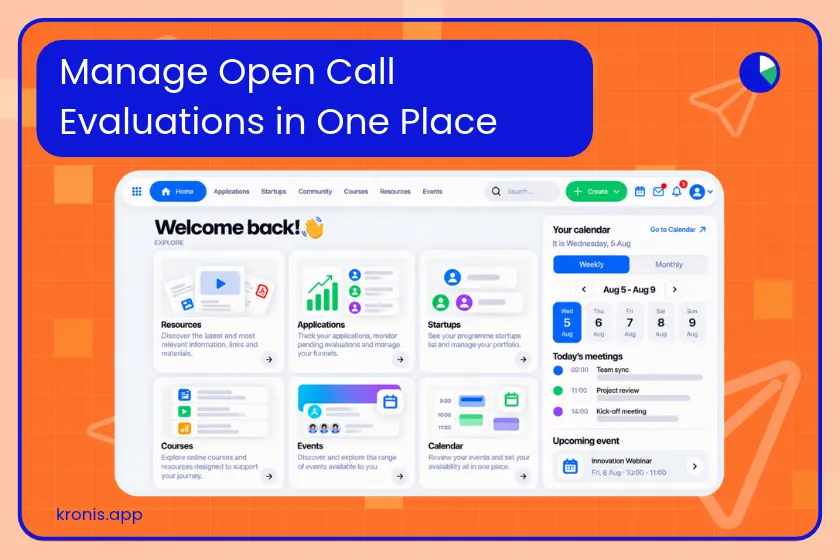
On the platform, programmes can manage their evaluation process alongside their application forms and the tracking of selected projects. Kronis Apply does not replace the rules in your Grant Agreement or call conditions. It gives the evaluation a single place to run, in line with the call’s own rules.
As of 16 October 2026, 14 EU-funded programmes run their open calls on Kronis Apply.
Kronis product
Prepare and submit applications to open calls without the last-minute chaos.
Key takeaways
- A defensible evaluation is one you can explain afterwards: the same criteria for every proposal, independent evaluators and a written record.
- Fix criteria and scoring before the call opens, and apply them to every proposal.
- Keep evaluator names, applicant lists, communications, evaluation forms and incident records from the start.
- Check your Grant Agreement and call conditions for what applies in your case. Co-funded Partnerships have additional rules.
See how it works: book a 20-minute demo to walk through evaluation management in Kronis Apply.