
Most Horizon Europe collaborative projects are built by a consortium, and the partners you choose shape the proposal as much as the idea does. Yet many coordinators still build consortia from personal contacts alone. Public data on EU-funded projects can show you who is already active in your field, what they have delivered and who they work with.
Why partner selection matters
The GEP criterion was introduced with the launch of Horizon Europe in 2021. It applies to calls with submission deadlines from 2022 onwardsH2: What the GEP eligibility criterion is, across all parts of the programme.
The idea is simple. Organisations that receive EU research funding should have a structured, public commitment to gender equality in how they work.
Where to look for partners
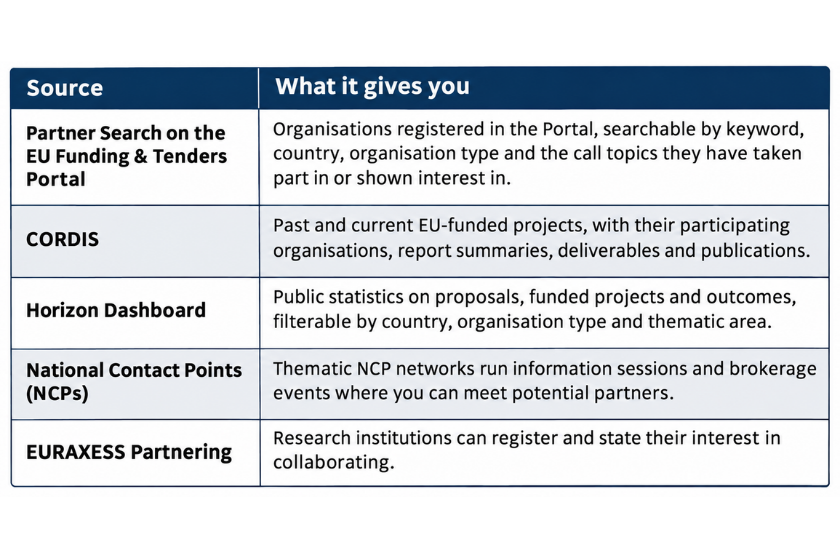
The Partner Search and brokerage events tell you who wants to join a project. Funded-project data tells you something different: who has already delivered one.
How to build a shortlist from funded-project data
- Start from the call topic. Pick the keywords and the expected outcomes of the topic you are targeting, not just your own technology.
- Find related projects. Search CORDIS for projects funded under similar topics in Horizon Europe and Horizon 2020. Recent projects matter most.
- List the organisations involved. For each project, note who took part and in what role: coordinator, partner or work package leader where the description makes it clear.
- Check their track record. How many EU projects has each organisation taken part in, and how recently? Have the projects published results, deliverables or publications?
- Look at who they work with. Organisations that appear together across several projects often have an established working relationship. That can be an advantage, or a closed group that is hard to join.
- Map the gaps in your consortium. Compare the shortlist against what your work plan needs: expertise, country mix and organisation types, such as universities, research organisations, SMEs or end users.
- Make contact early. Reach out before the call opens, when partners still have capacity and the consortium is not yet fixed.
Common mistakes to avoid
- Choosing names over capacity. A well-known organisation already committed to many projects may not have the people to deliver your work package.
- Ignoring the country mix. Meeting the minimum rule is easy; check that the countries also make sense for the work plan, for example where pilots or end users need to be.
- Duplicating expertise. Two partners with the same profile add cost without adding capability.
- Starting too late. Searching for partners after the call opens leaves little time to agree roles and budgets.
How Kronis Search brings this data together
Doing this by hand means switching between CORDIS, the Portal and spreadsheets for every topic. Kronis Search is a grant intelligence database that brings EU calls, funded projects and organisations together in one place:
- One searchable database, integrated with the European Commission’s CORDA data, covering more than 97,000 organisations and 27,000 active EU projects (data as of 16 October 2026).
- Search by country, organisation type, programme or topic, with each organisation’s activity level, project count and current work.
- Organisation profiling, to see who is active in a field and who they partner with.
- Saved searches and personalised reports, so you can return to a shortlist as a call approaches.
Kronis Search is currently in early access for existing Kronis customers.
Key takeaways
A strong consortium needs more than the minimum of three organisations from three countries: evaluators assess whether it can deliver the work plan.
Kronis product
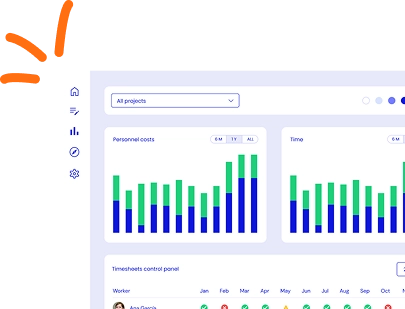
Run consortium and project management for EU-funded projects from one place.
- The Partner Search and brokerage events show who wants to join; funded-project data shows who has already delivered.
- Build your shortlist from the call topic, then check track record, existing collaborations and the gaps in your consortium.
- Contact potential partners before the call opens.
Want to see how Kronis supports EU project teams? Book a demo.