Cascade funding is one of the most accessible routes into EU innovation funding — smaller grants, faster timelines, and a simpler application process than a full Horizon Europe proposal. But “simpler” does not mean straightforward. Each call has its own eligibility criteria, thematic scope, and application requirements, and the process of finding the right call, confirming your eligibility, and submitting a competitive application has its own logic.

This guide walks through the process from start to finish — from identifying a relevant call to signing the sub-grant agreement.
Step 1: Understand what you are applying for
Before searching for calls, it is worth being clear about what cascade funding actually is and what it is not.
Cascade funding — formally known as Financial Support to Third Parties (FSTP) — is a mechanism through which organisations that have already received a Horizon Europe grant redistribute a portion of that funding to third parties through their own open calls. You are not applying to the European Commission. You are applying to a consortium that has been funded to run a programme and is now looking for organisations to support.
This distinction has practical consequences. The entity evaluating your application is not the Commission — it is the consortium. The rules, timeline, and evaluation process are defined by that consortium within the parameters set by their own Grant Agreement. Every cascade call is different.
Step 2: Find a relevant call
This is where most organisations spend the most time, and where the biggest inefficiency lies.
Cascade funding calls are published across dozens of different programme websites, consortium platforms, and project portals, and unlike standard Horizon Europe calls, they are not centralised in a single official database. The most practical starting point is cascadefunding.eu, which aggregates active cascade funding open calls from across Europe in one place, updated continuously. A call that is highly relevant to your organisation may be open for only a few weeks and subscribing to the daily newsletter ensures you do not miss it.
There are three practical ways to find cascade funding calls:
The EU Funding and Tenders Portal: The Commission’s central portal includes cascade funding calls, identifiable through the type of grants filter. However, coverage is incomplete. Many calls are published directly by consortia on their own platforms and do not appear in the central portal.
cascadefunding.eu: A dedicated hub that aggregates active cascade funding open calls from across Europe, including calls from Horizon Europe, Digital Europe, EIT & KICs, Interreg, Creative Europe, and more in one place. Subscribing to the daily newsletter ensures you do not miss relevant calls as they open.
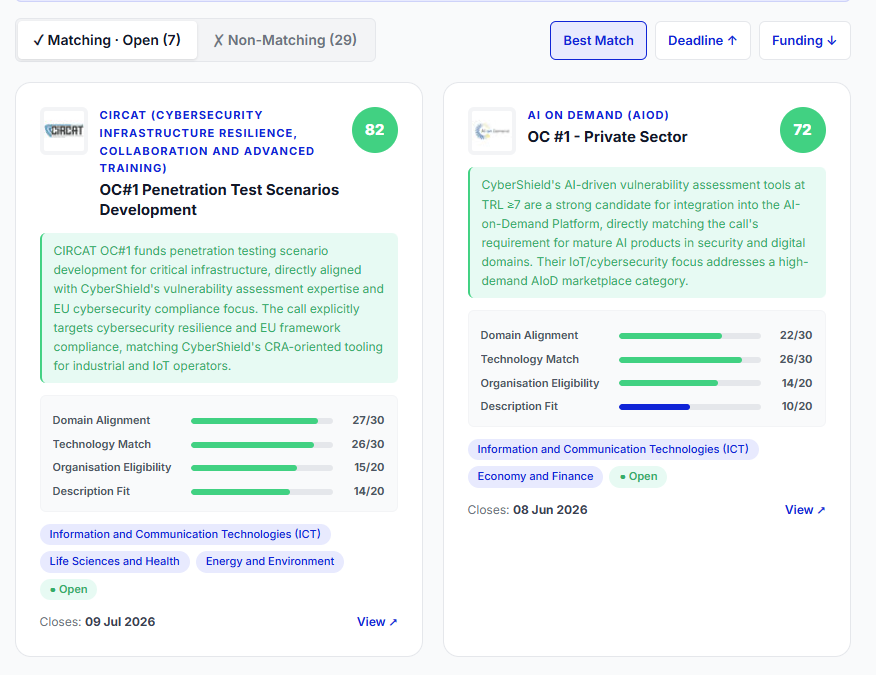
The Cascade Funding Matcher: The Matcher was built to solve exactly the problem of finding the right call efficiently. You describe your organisation: sector, country, technology focus, stage of development, number of employees, type of entity, or paste your website URL and let the AI extract the relevant profile information automatically. The Matcher then checks your profile against active and forthcoming cascade funding calls, scoring domain alignment, technology match, and legal eligibility, and returns a prioritised list of matching opportunities with score breakdowns and strategic advice in under two minutes.
What used to take half a day of manual searching now takes three minutes. Beyond identifying open calls, the Matcher also highlights relevant opportunities before they officially launch, giving you more time to refine your project idea, identify potential partners, and prepare a stronger application. Recent improvements combining AI reasoning with machine learning also deliver more accurate matches, clearer eligibility assessments, and more relevant strategic advice. The first search is free, with no credit card required. Enough to shortlist opportunities before committing to a subscription.
Step 3: Read the call documentation carefully
Once you have identified a potentially relevant call, read the full call documentation before doing anything else. This is not optional — eligibility conditions vary significantly between calls, and assumptions based on the call title or summary frequently turn out to be wrong.
The call documentation will specify:
Eligibility conditions: Who can apply. This typically includes entity type (SME, startup, research organisation, individual, etc.), size (number of employees, annual turnover), country of establishment, and in some cases the stage of development of the technology or business (TRL, revenue stage, years in operation).
Thematic scope: What the call is funding. Cascade calls have a defined thematic focus determined by the parent project’s objectives. Even if your organisation is technically eligible, your proposed activities must fit within the call’s scope.
Funding amount and conditions: How much is available per award, what costs are eligible, what the funding rate is, and what the project duration will be.
Application requirements: What you need to submit — typically a short proposal, a description of your organisation, financial information, and supporting documents.
Timeline: When the call opens and closes, when results will be announced, and when funded activities must start and end.
Read all of this before investing time in an application. A call that looks like a strong fit from the title may have an eligibility condition that rules you out immediately.
Step 4: Confirm your eligibility
Before writing a single word of the application, confirm that your organisation meets every eligibility condition specified in the call.
The most common eligibility filters in cascade funding calls are:
- Entity type: Many calls are exclusively for SMEs or startups. Some include research organisations and universities. Some are open to individuals. Check the exact definition used in the call — “SME” under EU rules means fewer than 250 employees and either annual turnover not exceeding €50 million or annual balance sheet not exceeding €43 million.
- Country of establishment: Some calls are restricted to specific countries or regions. Associated countries may or may not be included depending on the parent project’s rules.
- Stage of development: TRL requirements, revenue stage, or years since founding are common filters in deep tech and startup-focused calls.
- Previous funding: Some calls exclude organisations that have already received funding from the same parent project or programme.
If you are unsure about any eligibility condition, contact the call organisers directly. Most cascade funding calls have a designated contact point for eligibility questions, and getting a clear answer before investing in an application is always worthwhile.
Step 5: Prepare and submit the application
Cascade funding applications are significantly shorter and less complex than full Horizon Europe proposals — but they are still competitive, and the quality of the application matters.
The typical application for a cascade funding call includes:
Organisation description: Who you are, what you do, your legal status, and your relevant track record. This is not a generic company description — it should be tailored to demonstrate why your organisation is relevant to this specific call.
Project description: What you propose to do with the funding, how it relates to the call’s objectives, and what outputs you will produce. The project description should be specific, feasible, and clearly connected to the call’s expected results.
Impact and exploitation: How the funded activities will lead to concrete outcomes — commercial, scientific, or societal — beyond the project itself. Evaluators are looking for organisations that have thought seriously about what happens after the funding ends.
Budget: A breakdown of how the funding will be used, demonstrating that the requested amount is justified and proportionate to the proposed activities.
Supporting documents: These vary by call but typically include proof of legal entity status, financial accounts, and letters of intent from relevant partners or customers.
Step 6: The evaluation process
Once submitted, applications are evaluated by the call organisers — typically an independent panel of reviewers selected by the consortium. The evaluation criteria are specified in the call documentation and usually mirror the structure of Horizon Europe evaluation: excellence or innovation quality, impact, and implementation feasibility.
Timelines vary, but cascade funding evaluations are generally faster than full Horizon Europe proposal evaluations — results are often communicated within two to three months of the submission deadline.
If your application is unsuccessful, most call organisers provide feedback. This feedback is worth reading carefully — it is the most direct signal available about what needs to improve in a resubmission or a future application.
Step 7: The sub-grant agreement and project execution
If selected, you will be invited to sign a sub-grant agreement with the consortium. This is not a Grant Agreement with the European Commission — it is a contract with the consortium that manages the parent project. Its terms are defined by the consortium within the parameters of their own GA.
The sub-grant agreement will specify your obligations: what activities you must carry out, what outputs you must produce, what reporting is required, and how payments will be made. Take it as seriously as you would a standard Horizon Europe GA — because non-compliance can trigger recovery of funds, and the consortium is accountable to the Commission for the quality of the third parties it funds.
Once the project starts, maintain proper records of your activities and costs from day one. Even in smaller cascade funding projects, the documentation requirements are real — and they are checked.
Final thoughts
Cascade funding is one of the most accessible routes into EU innovation funding — but accessible does not mean effortless. Finding the right call, confirming eligibility, and preparing a competitive application all require time and deliberate effort.
The organisations that do it efficiently are those that have a systematic approach: a reliable source for call discovery, a clear eligibility-checking process, and a focused application that speaks directly to what the call is looking for.
For call discovery, the Cascade Funding Matcher handles the shortlisting — AI eligibility check, scored results, and strategic advice in under two minutes. Three free searches, no credit card required.
For organisations that want expert support writing a competitive application — from call selection and eligibility validation to proposal writing and impact positioning — Sploro’s startup and scaleup service provides exactly that. Cascade funding proposals are one of their core specialisms: fast turnaround, scoring-aligned, and built around how evaluators actually assess applications.
The tools and the expertise exist. The question is how much of the process you want to run yourself.
From grant searching to managing it: see Kronis at Startup Olé 2026
Horizon Europe vs cascade funding: which route is right for your organisation?