
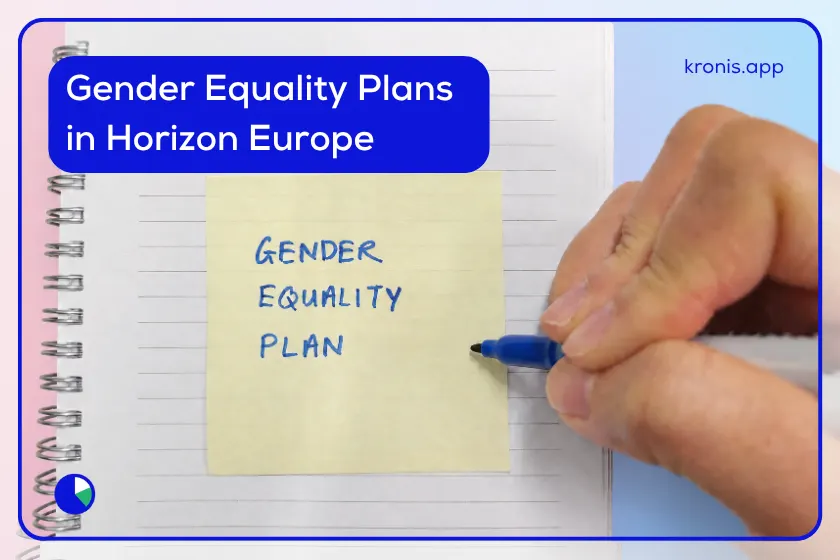
For many organisations, a Gender Equality Plan (GEP) is not optional in Horizon Europe: it is an eligibility criterion. Without one, a university, research organisation or public body cannot take part in a funded project. This guide explains who needs a GEP, the four requirements it must meet and how compliance is declared.
Your solution for navigating grants
With Kronis PMO, we make the process simple.
Book a free demo with us nowWhat the GEP eligibility criterion is
The GEP criterion was introduced with the launch of Horizon Europe in 2021. It applies to calls with submission deadlines from 2022 onwardsH2: What the GEP eligibility criterion is, across all parts of the programme.
The idea is simple. Organisations that receive EU research funding should have a structured, public commitment to gender equality in how they work.
Who needs a Gender Equality Plan
The criterion applies to three types of organisation, when they are established in an EU Member State or a Horizon Europe associated country:
- Public bodies, including research funding bodies, national ministries, other public authorities and public for-profit organisations.
- Higher education institutions, both public and private.
- Research organisations, both public and private.
Other types of organisation, such as private for-profit companies (including SMEs), NGOs and civil society organisations, are not subject to the criterion. Nor are organisations from non-associated third countries. They can still adopt a plan voluntarily.
The four mandatory requirements
To count for Horizon Europe, a GEP must meet four process-related requirements:
- Public document. The GEP is a formal document, published on the organisation’s website, signed by top management and actively communicated within the organisation.
- Dedicated resources. It includes a commitment to provide enough resources and gender equality expertise to implement it.
- Data collection and monitoring. It is based on sex- or gender-disaggregated data on personnel (and students, where relevant), with annual reporting against specific indicators.
- Training. It includes awareness-raising and training on gender equality for the whole organisation, including training on unconscious gender bias for staff and decision-makers.
All four are required. A plan with good objectives but no resources, no data or no training does not meet the criterion.
The five recommended content areas
Beyond the mandatory requirements, the Commission recommends that a GEP address five areas:
- Work-life balance and organisational culture
- Gender balance in leadership and decision-making
- Gender equality in recruitment and career progression
- Integration of the gender dimension into research and teaching content
- Measures against gender-based violence, including sexual harassment
These areas are recommended, not mandatory. They are still a good structure for a plan that has real effect inside the organisation.
How compliance is declared
Organisations do not upload their GEP when they apply. Instead:
- They confirm it through a self-declaration: an online questionnaire, completed at proposal stage, confirming that a GEP is in place. It is completed by the LEAR, the person who manages the organisation’s data in the Funding & Tenders Portal, in principle only once for the whole programme.
- The Commission carries out random compliance checks. If an organisation does not meet the four requirements, standard non-compliance procedures apply, and its participation can be terminated.
- Equivalent documents are accepted. If another strategic document, such as an inclusion or diversity strategy, meets the four mandatory requirements, it counts as a GEP.
Before a proposal deadline, it is worth checking that your organisation’s plan is published, signed and still current. A plan that has expired or is no longer on the website may not meet the first requirement.
GEP vs the gender dimension in research content
The two are easy to confuse, but they work at different levels:
- The GEP is about the organisation: its staff, leadership, recruitment and culture. It is an eligibility criterion.
- The gender dimension in research and innovation content is about the project itself: whether sex and gender analysis is relevant to the research. Applicants address it in the methodology section of their proposal, where evaluators assess it.
An organisation can have an excellent GEP and still submit a proposal that ignores the gender dimension of its research, or the other way round.
Kronis product
Run consortium and project management for EU-funded projects from one place.
Key takeaways
- A GEP is an eligibility criterion for public bodies, higher education institutions and research organisations in EU Member States and associated countries, for calls with deadlines from 2022 onwards.
- It must meet four requirements: a public, signed document; dedicated resources; data collection and monitoring; and training.
- Compliance is declared through a self-declaration at proposal stage, and equivalent strategic documents are accepted.
- The GEP is separate from the gender dimension in research content, which is addressed in the proposal itself.
For more on how the programme works, read our plain-language guide to how Horizon Europe funding works.
What is a Horizon Europe project kick-off meeting and what should it cover?
From grant searching to managing it: see Kronis at Startup Olé 2026